GEOTECHNICAL ENGINEERING
MEMPHIS
HomeLaboratoryTriaxial test

Triaxial Testing in Memphis, TN: Shear Strength Parameters for Foundation Design

Technical studies that support your project.

LEARN MORE

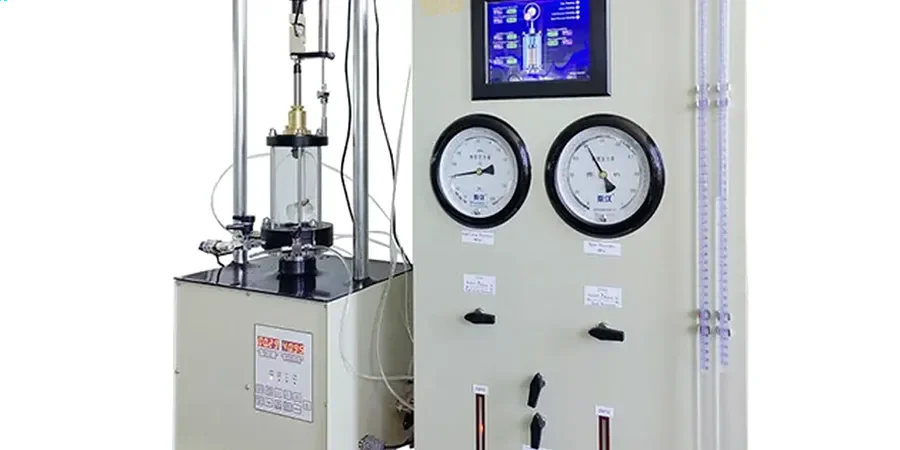
The New Madrid Seismic Zone, the most seismically active area east of the Rockies, underlies Memphis. Foundation conditions vary dramatically within a single city block because development occurred on the Mississippi River bluffs and the Wolf River floodplain. While a standard penetration test provides an index, critical infrastructure such as the I-40 bridge approaches and the massive FedEx World Hub requires constitutive soil parameters. Engineers rely on the triaxial test for this purpose. It replicates the in-situ stress state on a cylindrical specimen and measures how Memphis loess, alluvial sands, or stiff clays respond under deviatoric loading. Consolidated-undrained (CU) and consolidated-drained (CD) stages are run in the lab to capture effective stress paths that feed directly into finite element models. For deep excavations in the Jackson Formation or levee improvements along the Mississippi, the triaxial test provides the Mohr-Coulomb envelope and pore pressure response that SPT blow counts alone cannot offer.

In the New Madrid zone, a 2-degree difference in the friction angle changes the liquefaction factor of safety by 15 percent. Triaxial precision is non-negotiable.
Our service areas

Scope of work

Field crews in Memphis know the local loess can stand vertically when dry but collapses under saturation. The triaxial test quantifies this transition from peak strength to critical state. Our lab prepares specimens from Shelby tube samples taken across Shelby County, trimming them to a 2.8-inch diameter within a temperature-controlled chamber. Saturation follows a back-pressure procedure until Skempton’s B parameter exceeds 0.95. Then isotropic consolidation restores the effective overburden pressure estimated from site stratigraphy. The shearing stage runs at a strain rate slow enough to allow pore pressure equalization—typically 0.05% per minute for fine-grained soils per ASTM D4767. For projects near the Wolf River where soft clays govern the design, we often pair the triaxial test with in-situ permeability measurements to validate the consolidation coefficient used in settlement predictions.
  • Specimen saturation monitoring via B-value check at each confining stage
  • Axial strain measurement using submersible LVDTs mounted on the specimen
  • Pore water pressure transducer with automatic volume change device for drained tests
  • Stress path plots exported directly to PLAXIS and FLAC3D input formats
Triaxial Testing in Memphis, TN: Shear Strength Parameters for Foundation Design
Technical reference — Memphis

Area-specific notes

Per USGS hazard maps, Memphis is located just 40 miles from the southern leg of the New Madrid fault, with a 7–10% probability of a magnitude 6.0 or greater earthquake in the next 50 years. A foundation designed solely on unconsolidated-undrained (UU) parameters may miss the strength gain from consolidation under long-term loading. The real risk emerges when a structure experiences rapid cyclic loading: pore pressures increase, effective stress decreases, and a contractive sand can flow-liquefy. The triaxial test, conducted under CU conditions with pore pressure measurement, reveals this vulnerability before construction begins. Owners who omit this step may face differential settlement across the loess-bluff transition zone, a condition that has historically damaged buildings along North Parkway and the medical district.

Need a geotechnical assessment?

Reply within 24h.

Email: contact@geotechnicalengineering1.org

Standards used


ASTM D4767-11, ASTM D2850-15, ASTM D7181-20

Reference parameters

ParameterTypical value
Test standard followedASTM D4767 (CU), ASTM D2850 (UU), ASTM D7181 (CD)
Specimen diameter2.8 in (71 mm) typical; 1.4 in for gravelly material
Confining pressure range5 to 200 psi (covers 30 ft to over 400 ft depth)
Strain rate (CU on clay)0.05% per minute (ensures pore pressure equalization)
Saturation checkSkempton B-value ≥ 0.95 before shear phase
Reported parametersc’, φ’, c_u, E_50, ν’, Af at failure (Skempton’s pore pressure coefficient)
Typical Memphis soilsLoess (ML), Jackson Formation clay (CH), alluvial sand (SP-SM)

Top questions


What does a triaxial test cost for a single Shelby tube sample from a Memphis site?

The fee for a full CU triaxial set (three specimens consolidated at different confining pressures) with pore pressure measurement and stress path plots ranges from US$1,980 to US$2,380, depending on the required strain rate and whether a drained (CD) stage is needed. A single UU test costs at the lower end of that range. The price includes specimen trimming, saturation monitoring, shearing, and a signed report with Mohr-Coulomb parameters ready for your geotechnical report.

How long does a CU triaxial test take on Memphis loess?

A complete CU triaxial program on three loess specimens usually requires 8 to 10 working days. For these silty soils, saturation alone can take 3 to 4 days because their initial degree of saturation is often below 60 percent when the Shelby tube arrives. Consolidation adds another 24 to 36 hours per specimen, and shearing at 0.05% per minute takes roughly 10 hours per specimen. We send preliminary friction angles as soon as the first specimen fails, so your foundation design can proceed while the remaining tests finish.

Which triaxial type do Memphis engineers specify for New Madrid seismic design?

For seismic response analysis under the New Madrid hazard, engineers almost always specify a CU triaxial test with pore pressure measurement. This captures the undrained behavior—critical for liquefaction assessment—while still yielding effective stress parameters (c’ and φ’). Some projects add a cyclic triaxial stage (ASTM D5311) to measure the number of loading cycles to liquefaction at different cyclic stress ratios. We coordinate that testing with a university lab in the region when the project’s risk level demands it.

Location and service area

We serve projects across Memphis and surrounding areas. More info.

View larger map