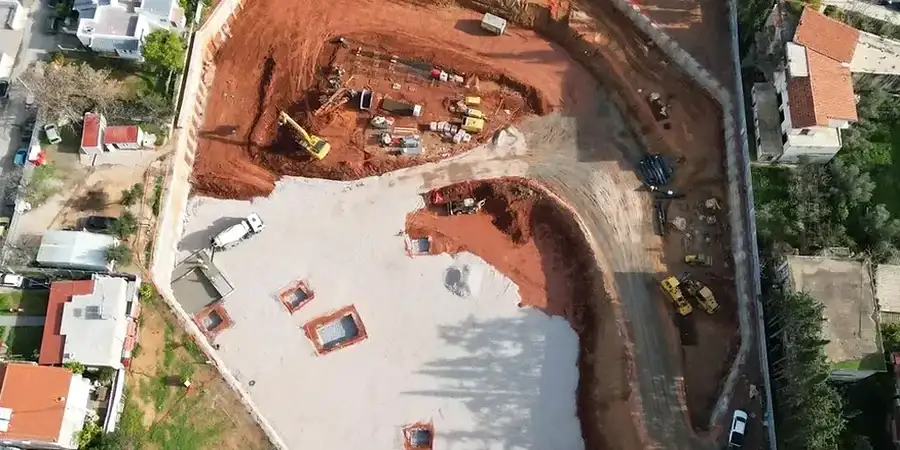
Memphis's subsurface conditions can change dramatically within a single block, making a structured excavation approach a vital risk management strategy that safeguards workers, nearby buildings, and the community, not just a regulatory requirement. Excavation work, whether for high-rise foundations in the downtown medical district or utility trenching across the Mississippi River floodplain, is a critical construction phase. It involves the entire process from site investigation and geotechnical design of cuts and retaining systems, through construction execution, to long-term monitoring.
Memphis sits atop the Mississippi Embayment, a deep basin filled with hundreds of feet of unconsolidated sediments. Near the surface, contractors routinely encounter the Jackson Formation's stiff silts and clays, often overlain by Pleistocene loess—a wind-deposited silt notorious for its ability to stand vertically when dry but collapse rapidly when saturated. The water table typically lies within 10 to 20 feet of the surface, introducing significant groundwater control challenges. These conditions demand specialized expertise in geotechnical analysis for soft soil tunnels, where face stability and ground loss predictions govern both safety and schedule.
Local excavation practice is shaped by both national standards and Tennessee-specific regulations. OSHA's Subpart P (29 CFR 1926.650) sets mandatory sloping, benching, and shoring requirements for all trenches deeper than five feet. The Tennessee Department of Environment and Conservation (TDEC) enforces sediment and erosion control permits under the Tennessee Water Quality Control Act, while the City of Memphis Engineering Division requires right-of-way excavation permits with detailed traffic control and restoration plans. For deep excavations adjacent to existing buildings, the 2021 International Building Code—adopted with local amendments—mandates lateral support designs that limit ground movement to protect neighboring foundations, often necessitating geotechnical design of deep excavations using advanced numerical modeling.
The range of projects that trigger significant excavation in Memphis is broad. Healthcare expansion on the Shelby County medical campus demands deep basements and utility vaults in tight urban settings. The city's ongoing sewer separation program requires extensive trenching through mixed ground, often below the water table. Transportation projects, including the I-55/Crump Boulevard interchange reconstruction, involve cuts up to 40 feet deep through loess and alluvium. Industrial facilities along President's Island must excavate for heavy foundation mats and underground containment structures, frequently encountering contaminated soils that add environmental permitting complexity. Each of these scenarios benefits from continuous geotechnical excavation monitoring to validate design assumptions and trigger contingency measures before small movements become structural problems.
During excavation, careful planning for groundwater control and soil support is essential to avoid sudden collapses, due to the combination of a high water table (within 10-20 feet of the surface), Pleistocene loess that stands vertical when dry but collapses quickly when wet, and the shrink-swell behavior of stiff clays from the Jackson Formation.
For work involving public streets, a City of Memphis right-of-way excavation permit is required. If the project disturbs more than one acre, a TDEC Construction General Permit for stormwater discharges is needed. Shoring systems deeper than five feet demand a building permit with structural review. Additionally, projects near waterways may necessitate a USACE Section 404 permit.
All trenches five feet or deeper must have protective systems such as sloping, benching, or shoring, as per OSHA Subpart P. A competent person is responsible for classifying the soil (Type A, B, or C) and inspecting the excavation on a daily basis. In Tennessee, an OSHA-approved State Plan enforces the same federal standards for worker safety.
When excavations go deeper than 10 feet, are next to existing buildings, or face challenging groundwater conditions, a geotechnical engineer is typically needed. The International Building Code (IBC) mandates that lateral support designs be sealed by a licensed professional engineer. Bringing an engineer in early during planning can help avoid expensive redesigns and construction delays.