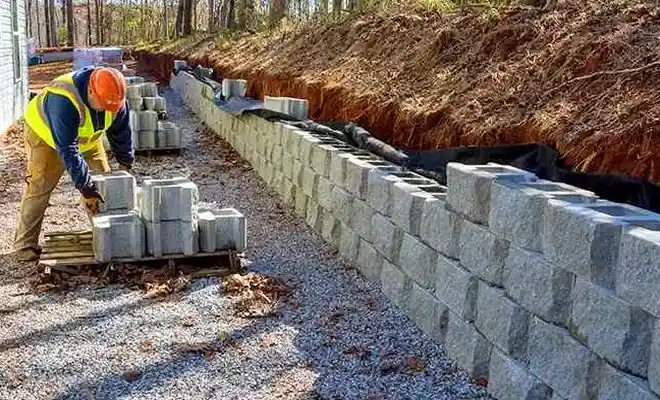
Along the Wolf River's steep loess bluffs and the cut slopes of Interstate 240, projects in Memphis require a thorough grasp of how local soil, water, and geometry interact. The city's terrain, shaped by Mississippi River bluffs and tributary drainage, makes slope and wall engineering crucial for protecting infrastructure, development, and public safety. This field covers analyzing, designing, and repairing natural and man-made slopes along with structural or mechanically stabilized walls that hold back soil and rock. At the intersection of natural terrain, constructed earthworks, and retention systems, these efforts safeguard property and lives.
Memphis sits atop a unique geological setting dominated by thick loess deposits—wind-blown silt dating to the Pleistocene—overlying Tertiary sands and clays of the Jackson Formation. Loess is metastable; it can stand near-vertically when dry but loses significant strength when saturated, triggering sudden collapse or progressive slope failures. This behavior, combined with the city's humid subtropical climate featuring intense rainfall events, creates a landscape where slope stability analysis is not optional but essential. The Mississippi Embayment's deep alluvial history further complicates subsurface conditions with artesian groundwater pressures and relic landslide features that demand careful geotechnical characterization before any wall or slope design proceeds.
With the New Madrid Seismic Zone imposing a moderate seismic hazard, geotechnical reports in Memphis must show a factor of safety of 1.5 for permanent slopes and 1.3 under seismic conditions per ASCE 7. Multiple authorities govern regulatory compliance: the state-adopted International Building Code (IBC) sets structural design loads including lateral earth pressures; the Tennessee Department of Transportation (TDOT) Standard Specifications dictate requirements for MSE walls and reinforced slopes on public works; and the Memphis and Shelby County Unified Development Code enforces grading permits, erosion control, and minimum safety factors against sliding and bearing for hillside developments. These sources collectively ensure rigorous standards.
The types of projects requiring slopes and walls expertise in Memphis span transportation corridors, commercial developments, and flood infrastructure. Highway widening along I-55 and I-40 corridors frequently involves retaining wall design to maximize right-of-way while maintaining stable cuts. Institutional campuses on the city's eastern bluffs, including hospital expansions, rely on tiered retaining systems and reinforced slopes to create buildable pads. Levee improvements along the Mississippi River and its tributary streams integrate slope armoring and drainage systems to combat erosion and underseepage. Industrial sites near Presidents Island demand heavy-duty anchored bulkheads capable of withstanding both river stage fluctuations and seismic loading. In each case, the integration of active/passive anchor design into wall systems can deliver the additional restraint needed when space constraints or soil conditions preclude gravity solutions alone.
Due to loess's metastable structure, failures typically happen abruptly after extended wet spells instead of gradual creep. The main trigger is loess saturation from heavy rain or inadequate drainage, which diminishes suction and causes swift strength reduction. Additional factors are uncontrolled stormwater runoff, leaking pipes, excavation lacking proper benching, and ongoing erosion along creek banks.
Walls are required where slope angles violate local grading code allowable steepness or where maintaining vegetated slopes long-term is not feasible. Additionally, a retaining wall becomes necessary when limited space prevents a stable slope geometry, when right-of-way restrictions exist, or when surcharge from structures or traffic necessitates a vertical face. The selection among gravity, cantilever, MSE, or anchored walls depends on wall height, soil conditions, and loading.
Under the New Madrid Seismic Zone's influence, geotechnical designs in Memphis must incorporate seismic loading. Liquefaction of saturated sands underlying loess must be evaluated because strength loss in foundation soils can destabilize otherwise secure walls. For slopes, pseudostatic stability analysis with horizontal accelerations of 0.1g to 0.2g is required. Retaining walls must also consider dynamic earth pressure increments as per AASHTO or IBC provisions.
To ensure long-term performance, TDOT specifications for public walls require particular filter aggregate gradations and geotextile separation that stop fines from loess migrating into drainage systems. Additionally, Memphis and Shelby County codes mandate positive drainage behind all permanent retaining walls to avoid hydrostatic pressure buildup. This typically involves a continuous drainage blanket, perforated collector pipes that daylight to approved outlets, and waterproofing where walls meet occupied areas.