GEOTECHNICAL ENGINEERING
MEMPHIS
HomeLaboratoryProctor test (Standard or Modified)

Proctor Test (Standard and Modified) in Memphis, TN

Technical studies that support your project.

LEARN MORE

Compaction control in Memphis isn't just about passing a field density test. It starts in the lab with a Proctor curve that actually represents the fill you're hauling in. ASTM D698 (Standard Proctor) and D1557 (Modified Proctor) define the moisture-density relationship, and the difference between them can shift a spec from 95% to 98% relative compaction overnight. On sites across Shelby County, from the loess-bluff line east of downtown to the Mississippi River alluvium west of I-240, the lab's choice of compaction energy has to match the structural load. When a retaining wall goes up behind a new warehouse in Frayser, we often see specs calling for Modified Proctor at 98% under the footing zone, while the general pad fill stays on a Standard curve. Pairing the lab work with a field sand cone density check closes the loop between the moisture target and what the roller actually achieves.

A Proctor curve built on the wrong compaction energy can make a passing fill look like it failed—or worse, pass fill that shouldn't have passed.
Our service areas

Scope of work

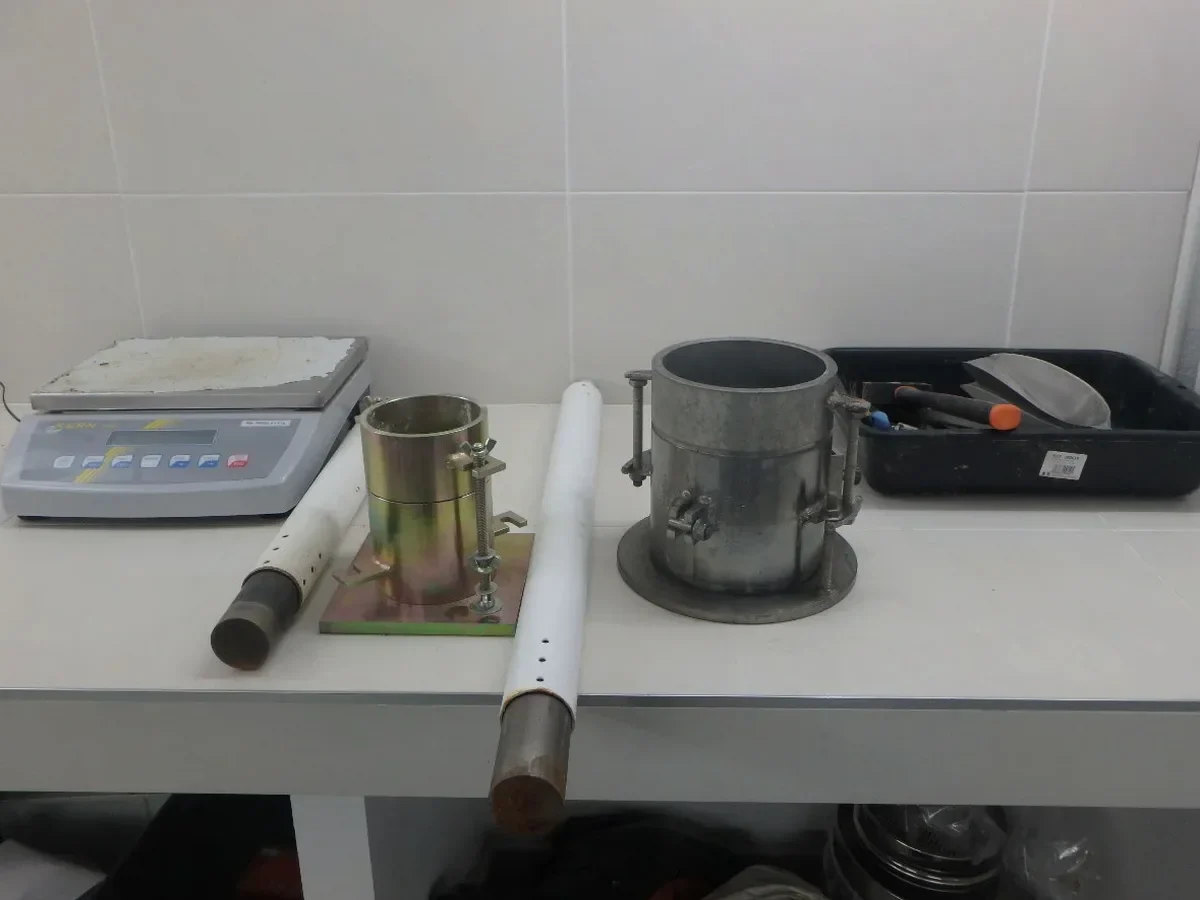
Memphis sits at roughly 337 feet above sea level on a bluff that drops sharply into the Mississippi floodplain, and that 100-foot elevation change means two sites a mile apart can be working with completely different borrow sources. One job might be cutting into the Peoria Loess and recompacting it as structural fill; another might be importing brown silt from a pit in West Memphis, Arkansas. The Proctor test defines the baseline. Standard Proctor uses a 5.5-lb hammer dropped 12 inches in a 4-inch mold, delivering 12,400 ft-lbf/ft³ of compactive effort. Modified Proctor jumps to a 10-lb hammer dropped 18 inches, hitting 56,000 ft-lbf/ft³—more than four times the energy. For Memphis DOT road subgrades or building pads under IBC Chapter 18, the Modified test is the default because it simulates the heavy compaction equipment common on commercial sites. The lab runs both single-point and five-point curves, reports optimum moisture and maximum dry density, and flags soils with gypsum or high organic content that can skew the curve. Every result gets tied to a USCS classification from ASTM D2487 so the field tech knows exactly what material the curve governs.
Proctor Test (Standard and Modified) in Memphis, TN
Technical reference — Memphis

Area-specific notes

Consider two locations: the Poplar Corridor area, underlain by Pleistocene loess, and the President's Island industrial district, where Holocene alluvium near the Mississippi River is present. The loess typically achieves Proctor maximum dry densities ranging from 105 to 110 pcf, with optimum moisture content around 14–16%. If compacted excessively wet of optimum, it quickly loses strength. In contrast, the river alluvium, which contains more clay and silt, may only reach 95 pcf with optimum moisture exceeding 20%, demanding a completely different field compaction target. Performing a Modified Proctor test on loess without accounting for its collapse potential upon wetting yields a curve that looks acceptable theoretically but fails under an actual Memphis summer thunderstorm. Conversely, using Standard Proctor for alluvium when the specification assumed Modified Proctor means the contractor pursues a density unattainable with the available equipment. The New Madrid seismic zone introduces further complexity: fill subjected to wet-dry cycles based on a loose Proctor baseline can undergo differential settlement even in a moderate earthquake, leading to slab cracking and broken utility connections. The laboratory must identify these discrepancies before any fill placement begins.

Need a geotechnical assessment?

Reply within 24h.

Email: contact@geotechnicalengineering1.org

Watch how it works


Standards used

ASTM D698-12, ASTM D1557-12e1, ASTM D2487-17, IBC 2018 (Chapter 18)

Reference parameters


ParameterTypical value
Test standardASTM D698 (Standard), ASTM D1557 (Modified)
Hammer mass5.5 lb (Standard) / 10 lb (Modified)
Drop height12 in (Standard) / 18 in (Modified)
Mold volume1/30 ft³ (4-inch mold)
Compactive effort12,400 ft-lbf/ft³ (Standard) / 56,000 ft-lbf/ft³ (Modified)
Typical moisture range8%–25% depending on soil plasticity
Method optionsA, B, C per particle size (up to 3/4 in sieve)
Reported valuesOptimum moisture content, Maximum dry density (pcf)

Top questions

How much does a Proctor test cost in Memphis?

For a five-point Standard or Modified Proctor curve, costs generally fall between $90 and $240, varying with the test method and whether we use an existing family of curves or begin from scratch. One-point checks are priced at the lower end of this spectrum. A precise quote will be provided after we receive the soil classification and project specifications.

Which Proctor test does IBC require for building pads in Memphis?

According to Chapter 18 of the IBC, ASTM D1557 (Modified Proctor) is the required standard for structural fill beneath footings and slabs, except when the geotechnical report dictates an alternative. In Memphis, the default for commercial projects is Modified Proctor with 95% or 98% relative compaction. However, for light load residential additions on loess, Standard Proctor might be acceptable.

How long does it take to get results back?

Our standard processing time is 48 hours from the time you drop off the sample. We conduct moisture content determination in our lab ovens overnight, then perform compaction the following morning, with the final curve plotted by close of business. For teams urgently needing a density target, we offer a rush service with 24-hour turnaround.

Can you run a Proctor on fill that already has gravel or rock fragments?

Affirmative. Both ASTM D698 and D1557 encompass Method B, which uses material passing a 3/8-inch sieve, and Method C, for material passing a 3/4-inch sieve. When the fill contains particles larger than 3/4 inch, we implement a rock correction following ASTM D4718 to modify the curve so that it reflects the entire material composition, not solely the fine fraction.

Location and service area

We serve projects across Memphis and surrounding areas.

View larger map